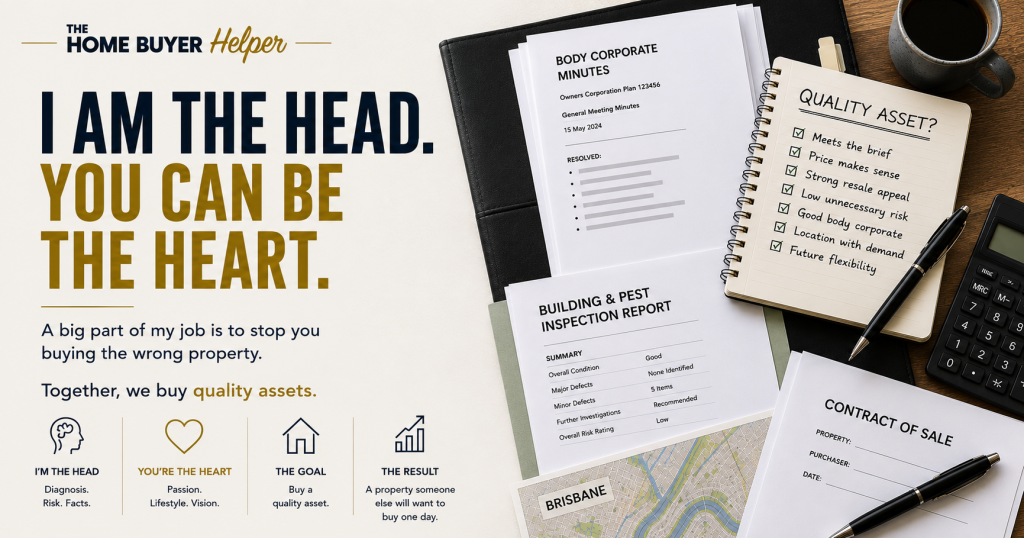
Every purchase decision has two halves. One is pulse — instinct, excitement, imagination. The other is diagnosis — is this thing actually worth buying? Yours is to feel the pulse. Mine is to run the diagnosis.
I’m the head. You’re the heart.
That’s the line I open with more often than not, and it usually needs unpacking.
“A big part of my job is to stop you buying the wrong property.”
It usually gets a laugh.
People don’t expect to hear that from a buyer’s agent. After all, you’ve engaged me to help you buy a home. Why would I be talking about stopping you?
Because my job isn’t just to help you buy a property. It’s to help you buy a quality asset. There’s a big difference.
Buying a home should be emotional. Whether it’s your first home, your forever home or somewhere to downsize, I want you picturing yourself living there! Imagining Christmas lunch on the deck, where the couch will go, whether the dog has enough backyard to run around. That’s your job.
Mine is different. While you’re picturing your future there, I’m asking whether we’re making a smart decision. Every time I inspect a property, I ask myself one question.
Is this a quality asset?
You’ll hear me use that phrase a lot, because I think it’s one of the most important questions any buyer can ask. And I don’t mean does it have stone benchtops or a renovated bathroom — that’s the obvious stuff.
To me, a quality asset is fit for purpose for the client standing beside me today, but it’s also a property someone else will want to buy one day. It meets the brief. The price makes sense. It has strong resale appeal. It doesn’t carry unnecessary risk.
Because someone else is going to own this property one day, whether that’s in five years or twenty. If I wouldn’t be comfortable buying it knowing what I know today, I can’t recommend that you do.
That philosophy has led to some uncomfortable conversations over the years.
The apartment that was $150,000 “too cheap”
This is exactly the kind of thing I’m checking for before I even walk through the front door. One client rang me incredibly excited because an agent he’d met months ago called him about an apartment $150,000 cheaper than comparable properties. On paper it looked fantastic. The location suited his brief. The photos were great. The floor plan worked. He thought he’d found the bargain of the year.
Then we started reading the body corporate records.
The body corporate had taken legal action against the developer over building defects.
They lost.
The result was a significant special levy every owner had to pay every quarter for years.
My client wasn’t overly worried. His view was simple: “Even after paying the levy, I’m still in front.”
I wasn’t convinced. Not because of the levy we now knew about. I was worried about the next one. If the sinking fund and administration fund were being drained just to deal with existing issues, what happens if another major defect appears before those funds recover?
The owners pay again. That’s not a risk I was prepared to recommend.
We walked away. A few weeks later we bought a better apartment in the neighbouring suburb. It wasn’t the cheapest property. It was the better asset.
The bedrooms that weren’t quite bedrooms
Another time, we’d already secured a property. Negotiation done, contract signed, everything moving toward settlement. Then the building and pest inspection uncovered something nobody had picked up.
Two of the three bedrooms had windows that couldn’t be opened.
That might not sound like much, but it raised a serious question about whether those rooms actually complied with the National Construction Code as habitable bedrooms. Suddenly the property we’d negotiated as a three-bedroom apartment carried the risk of being viewed very differently by future buyers.
Could we have proceeded? Sure.
Did I think we should? Not for a second.
Same question, different answer this time. We terminated the contract.
These days, I open and close every window at every inspection. Every single one. My clients think it’s a quirk. It’s actually a scar.
“But it’s in budget”
Those decisions aren’t always popular in the moment, especially with clients who’ve already spent months searching before they came to me.
Which brings me to a phrase that always makes me nervous: “But it’s in budget.”
I hear it most from people who’ve already done the hard yards before I even meet them. Too many Saturday open homes. A couple of near misses. Somewhere in there, “find the right property” turned into “just find something.” My job is to pull that back, to get you asking “Is this the right property?” again, not “Can we just buy something?”
Because a property doesn’t become a quality asset by being affordable. It becomes one by being worth owning.
Where a buyer’s agent actually earns their fee
One of the biggest advantages of working with a buyer’s agent isn’t that I’ll find properties you can’t. It’s that I’ll assess risk differently. While you’re picturing where the dining table will sit, I’m reading body corporate records and questioning why a “bargain” is a bargain. (If you’re wondering what that’s actually worth, I’ve broken down how buyer’s agent fees work in Brisbane elsewhere on the blog.)
None of that is designed to take the excitement out of buying property. It’s designed to protect you from one of the biggest financial mistakes you’ll ever make.
So, if we ever inspect a property together and I tell you I think we should walk away, understand this: I’m not trying to stop you buying a home. I’m trying to stop you buying the wrong one. Because that’s what you’ve engaged me to do.
You bring the heart. I’ll bring the head. Together, we’ll buy a quality asset.
If you’re weighing up a property and want a second opinion before you commit, get in touch — that conversation might be the best money you never spend.
Ric Medlin is the founder of The Home Buyer Helper, an independent Brisbane buyer’s agent helping owner-occupiers, downsizers and investors find quality assets — not just properties in budget. He works with clients across Brisbane and the Bayside to reduce risk and buy with confidence.